Personal injury narrative report template
Updated November 19, 2026. Includes a sample report you can download.
A personal injury narrative report tells an attorney or insurer what happened to the patient, what you found, how you treated it and what comes next. It usually covers the mechanism of injury, initial complaints and findings, imaging, the course of treatment, measured progress, diagnoses, a causation opinion, prognosis and future care.
Below is a section-by-section template, a sample report and what reviewers look for.
What goes in a personal injury narrative report?
Most narratives follow the order of the case, from the accident to today:
- Patient and case details: name, date of birth, date of injury, report date and the requesting party.
- History of the injury: how the accident happened, the patient’s position and immediate symptoms, and prior injuries to the same area.
- Initial complaints and examination: pain levels, findings and any neurological deficits at the first visit.
- Imaging and diagnostics: studies, dates and findings.
- Course of treatment: dates of care, number of visits, treatments, referrals and any gaps in care with the reason.
- Objective progress: outcome scores and pain levels at the start and at the latest visit.
- Diagnoses.
- Causation: your opinion on whether the injuries resulted from the accident, stated to a reasonable degree of professional probability.
- Prognosis and maximum medical improvement.
- Future care: recommended treatment with an estimate of visits or costs.
- Signature and credentials.
Template
Copy this outline into your own letterhead, or dictate each section in order.
- NARRATIVE REPORT
- Patient: [name] · DOB: [date] · Date of injury: [date] · Report date: [date]
- HISTORY OF INJURY
- On [date], [patient] was [mechanism of injury]. Symptoms began [when]. Prior injuries to this area: [none / describe].
- INITIAL PRESENTATION
- First seen on [date] with [complaints and pain ratings]. Examination showed [findings].
- DIAGNOSTIC IMAGING
- [study, date and findings]
- COURSE OF TREATMENT
- Treated [number] times between [dates] with [treatments]. Referrals: [provider and date]. Gaps in care: [none / dates and reason].
- OUTCOME MEASURES
- [score]: [initial] on [date]; [latest] on [date].
- DIAGNOSES
- [numbered list]
- CAUSATION
- Within a reasonable degree of [chiropractic / medical] probability, these injuries are [causally related / not causally related] to the [event] of [date].
- PROGNOSIS
- [good / fair / guarded / poor]. Maximum medical improvement: [reached on date / not yet reached].
- FUTURE CARE
- [recommended care, frequency, estimated visits or cost]
- SIGNATURE
- [name, credentials]
Sample narrative report
This one-page sample was produced in EasyDocForms Voice from a dictation. The patient, practice and providers are fictional.
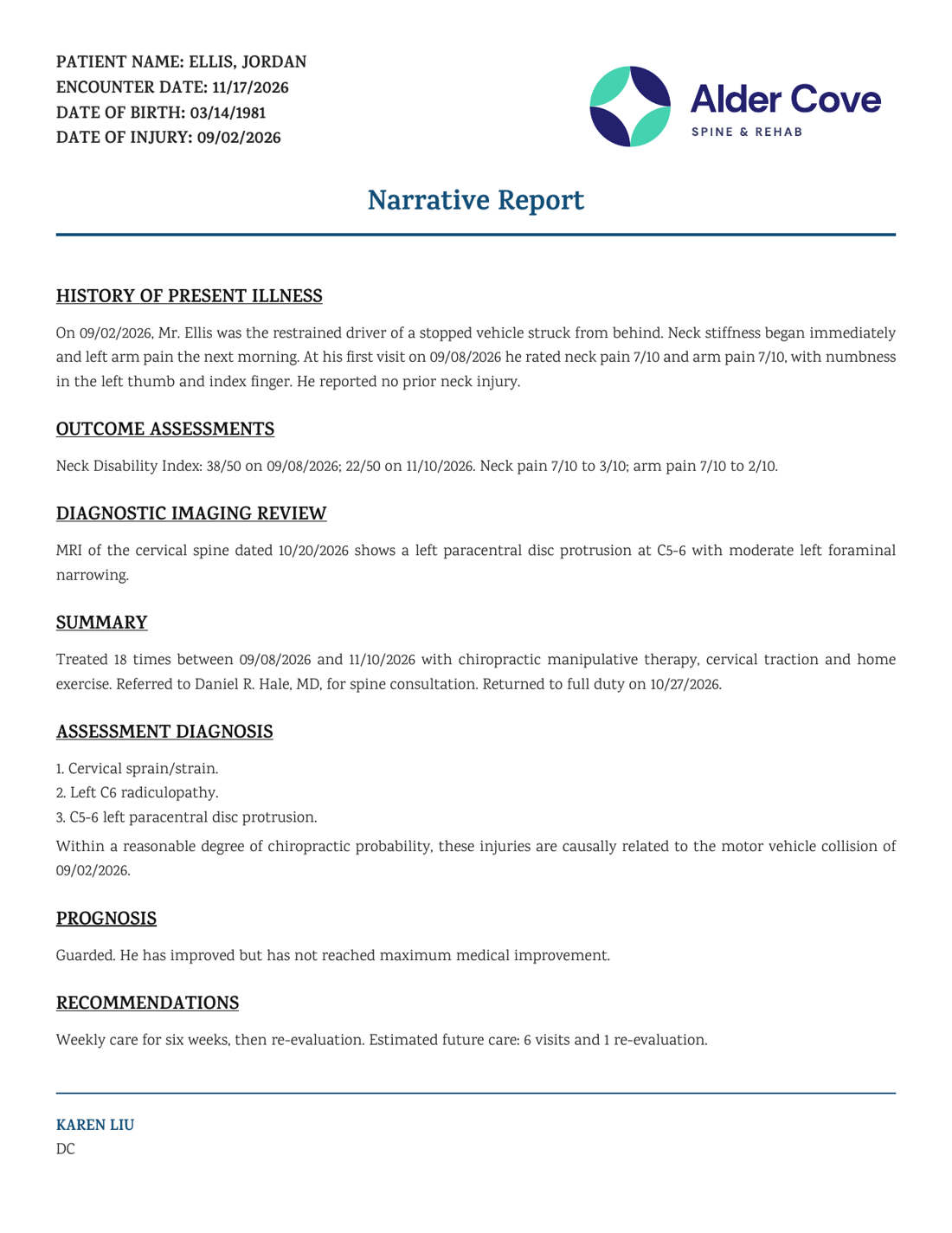
Dates tie every event to the accidentInjury, first visit, imaging, return to work
Progress is measuredNeck Disability Index and pain, first and latest
Causation in plain termsStated to a reasonable degree of probability
Future care is specificVisits and re-evaluation, counted
Download the sample PDFWhat attorneys and adjusters look for
- A story they can follow without rereading the whole chart.1
- A clear timeline from the accident to the latest visit.2
- Measurable findings and function, such as pain ratings, outcome scores and what the patient can’t do.
- A causation opinion that says the injury is more likely than not related to the accident.
- Explained gaps in care. Unexplained gaps raise questions.1
- A report that matches the treatment records.
Common mistakes
- Boilerplate that reads the same for every patient. Reviewers notice copied paragraphs, and it weakens the report.
- Missing dates for the first visit, imaging or the latest re-evaluation.
- No causation statement, or one that doesn’t name the accident and its date.
- Vague future care, such as “continue as needed” with no number of visits.
- An unsigned report or one without credentials.
Requirements vary by state and by case. Confirm what the requesting attorney or insurer needs.
How to produce this report from dictation
In EasyDocForms Voice, you dictate each part of the case in your own words. Voice puts them into the right sections and full sentences, then gives you a PDF on your letterhead to review and sign. It doesn’t add findings or filler you didn’t dictate.
If you already have a narrative format, Tailored setup ($500 once) rebuilds it, including your headings, section order and the causation wording you use every time.
Common questions
Who writes a personal injury narrative report?
The treating provider, such as the chiropractor, physician or physical therapist who examined and treated the patient. The opinions in it must be the provider’s own.
How long should a narrative report be?
There’s no set length. It should be long enough to cover each section clearly. Many single-provider narratives fit on one to three pages.
Can I use the same template for every patient?
Use the same structure, but write each section from that patient’s own history and findings. Identical paragraphs across patients undermine the report.
Is the sample report a real patient?
No. The patient, practice and providers in the sample are fictional.
Dictate your next narrative.
30 reports a month are free, then $2 a report. With Tailored setup, we rebuild the format of reports you already send.